

Barbra Rabson Reflects on 20 Years of Quality Initiatives in MA Healthcare in Opening Remarks at MHC Event
(May 2026)
 Barbra Rabson was honored to give the opening talk for a meeting hosted by the Mass Health Council focused on 20 years of quality improvement since the passage of Chapter 58. Chapter 58 is the landmark Massachusetts healthcare reform law that established near-universal health insurance coverage across the state. Signed into law on April 12, 2006, it mandated that nearly all residents obtain health insurance, established the Massachusetts Health Connector, and served as the blueprint for the national Affordable Care Act.
In preparing her comments, Barbra says she learned some interesting history about quality work in the Commonwealth and gained a deeper appreciation for the role MHQP has played in the Massachusetts quality landscape.
Below is a transcript of her remarks…
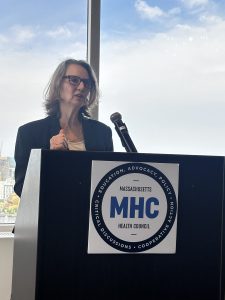 Thank you for the honor of speaking with you today about the quality journey we have been on in Massachusetts for the last 20 years. My reflections are through the lens as my role as president and CEO of the Massachusetts Health Quality Partners (MHQP). MHQP was established 30 years ago with a mission to improve the quality and equity of patient experiences of care in Massachusetts and we have been a pioneer in the measurement and public reporting of quality data in the Commonwealth for the past three decades.
When looking back decades, it is important to remember the context of the environment in which this work took place. It was fun for me to look up details of our quality journey in Massachusetts, and I will share that journey with you this morning. Here are three notable things that stood out for me:
- Massachusetts has been pioneer in the quality space for decades.
- We have been grappling with issues of quality, cost and equity for a long time. The structures created under Chapter 58 were a precursor to much of the work we now see through organizations like Health Policy Commission and the Center for Healthcare Information and Analysis.
- We repeatedly declare we want to make improvements, but we have not always made the investments and policy choices necessary to achieve the future we say we want, particularly around population health, primary care, and public health infrastructure.
Here is a select timeline from Massachusetts’ quality journey (please note for the sake of time, I left many things out):
It is important to note that in 2006 when Chapter 58 was passed, the quality measurement field was nascent in the United States. Also, it is significant that much of our national quality measurement progress had roots in Massachusetts.
In 1995, MHQP was formed and in 1998 we released the first-in-the-nation public report of patient experiences with acute care hospitals. This was 10 years before the federal government was measuring HCAHPS — or patient experiences with hospitals.
In 1999, the Institute of Medicine published To Err is Human, the landmark report that noted the number of people who die in hospitals each year as a result of preventable medical errors. Local safety leaders Lucian Leap (Harvard School of Public Health) and Don Berwick (IHI) were both instrumental in this work.
In 2001, the Institute of Medicine published Crossing the Quality Chasm, which established a definition for quality for the country — that it should be safe, effective, patient-centered, timely, efficient and equitable. Don Berwick was one of the lead authors on this study as well.
Then in 2005, one year before Chapter 58 passed, MHQP publicly released comparative quality reports — both clinical quality and patient experience results of how healthcare systems performed on a number of measures focused on preventive care and chronic disease management. This was a huge driving force for improvement work.
It is in this early quality measurement landscape (just 5 years after quality was defined) that Chapter 58, An Act Providing Access to Affordable, Quality, Accountable Health Care, passed in 2006. It was as we know, a landmark legislative effort that established near-universal healthcare coverage for Massachusetts.
But I am going to focus on another less noticed part of Chapter 58 — and remarkably forward-looking — which was to establish a Quality and Cost Council (QCC) for Massachusetts that had responsibility for:
- establishing statewide goals for improving health care quality, containing health care costs, and reducing racial and ethnic disparities in health care;
- demonstrating progress toward achieving those goals; and
- disseminating, through a consumer-friendly website, comparative quality and cost information.
This was a very ambitious vision in 2006.
The Quality and Cost Council was launched and ran through 2012. I am very familiar with the QCC because MHQP was selected as the independent contractor to provide technical assistance to the Council, including the development of health care quality goals, performance measurement benchmarks, and a 3 year reporting plan for a consumer health information website.
The QCC established ambitious goals, including:
- Reduce the annual rise in health care costs to no more than the unadjusted growth in Gross Domestic Product (GDP) by 2012.
- Promote cost-efficiency through development of a website that will enable consumers to compare the cost of health care procedures at different hospitals and outpatient facilities.
- Reduce disease complication rates, readmission rates and avoidable hospitalizations.
- Reduce, and ultimately eliminate, disparities in disease complication rates, readmission rates, and avoidable hospitalizations.
VERY BOLD, AMBITIOUS GOALS.
However, In November 2012, when Chapter 224 – An Act Improving the Quality of Health Care and Reducing Costs Through Increased Transparency, Efficiency and Innovation was enacted, the Quality and Cost Council officially sunsetted without these goals being achieved.
The QCC was not just eliminated; rather, its structural responsibilities and consumer transparency resources were broken up and distributed across newer, more powerful state entities. The Health Policy Commission (HPC): took over the core mission of state health care cost monitoring and setting cost growth benchmarks, and the Center for Health Information and Analysis (CHIA) tool over the public websites and tracking of quality metrics.
Today, over a decade later, HPC, CHIA and MHQP remain foundational institutions in Massachusetts healthcare. Yet despite the progress we have made, significant challenges around healthcare quality, affordability, and cost remain.
Some of the challenges we have experienced include:
- The alarming evolution of the corporatization and consolidation of health care
- The Steward Health Care system collapse
- The COVID pandemic
- All of these things contributing to the erosion of our primary care and public health systems
- Add to this the draconian cuts and war on evidence of this current federal administration and we get to where we are today, making it more difficult to achieve our quality and cost goals. But it is the choices that we make about healthcare spending and investments that have the biggest impact.
For example:
- The Commonwealth Fund’s annual state healthcare performance report ranks Massachusetts #1 in the nation, in part due to the Commonwealth’s great work on coverage. But there are rankings where we are the absolute worst in the nation. We rank 50th in 30-day hospital readmissions, 47th in preventable hospital admissions, and 46th on primary care spending as share of total healthcare spending for Medicare beneficiaries.
- When you step back, our worst performing measures point to a failure to prevent expensive hospitalizations and hospital readmissions, and yet we spend only about 6 cents on the dollar to support our primary care — despite the fact that the preventive care that primary care doctors and nurses provide saves lives and dollars.
This is clearly not sustainable. Because of this poor performance, the CMWF report also documents that Massachusetts has premium costs for employer-sponsored health insurance in the state of $22,000, soaring beyond the national average.
Another example of choices we make about healthcare spending are documented in the first-in-the-nation Dashboard on the health of primary care that MHQP and CHIA first produced in 2023.
The dashboard focuses on primary care financing, performance (access and quality), capacity and equity. All of these domains continue to worsen. Here is an example from the dashboard about primary care access:
- 30% of Mass residents report having a difficult time accessing primary care AND if you:
- Live in western Massachusetts, this goes up to 36.6%;
- Have been uninsured in the last 12 months, this goes up to 41.9%; or
- Have two or more chronic diseases, this goes up to 35.4% (v. 25.6 with no chronic disease). So the sicker you are, the harder it gets to access needed care.
These disparities extend beyond access. We see them reflected across the data MHQP collects and reports.
MHQP’s statewide patient experience survey data reveal significant racial and ethnic disparities in patient experiences of care. Data that MHQP has collected and aggregated from participating commercial payers for CHIA has also documented disparities across essential primary care services — including behavioral health, chronic conditions, maternity care, pediatrics, and preventive care.
These reporting tools are a mirror we hold up to ourselves that reflects our priorities, our investments, and our choices.
Some good news is that in 2024, through legislation passed in Chapter 343 – Act Enhancing the Market Review Process, Massachusetts launched a Primary Care Task Force. This Task force will be finalizing recommendations to the legislature next month including:
- Establishing a primary care spending target for private and public health care payers that reflects the cost to deliver evidence-based, equitable and culturally competent primary care — doubling the current spending
- Proposing payment models to increase public and private reimbursement for primary care services
- Assessing the impact of health plan design on health equity and patient access to primary care services
- Monitoring and tracking the needs of and service delivery to residents of the Commonwealth
This work represents an opportunity to move from identifying problems to making the commitment to build a strong primary care foundation for our healthcare system. To do this, we will need to make the investments and tradeoffs required, particularly around population health, primary care, and public health infrastructure if we want to achieve access to the affordable, quality, equitable and accountable health care we have long envisioned.