
CHA’s High Reliability Organization Initiative Helps Propel Windsor Street Primary Care to Patient Experience Awards
(April 2026)
“The biggest change I’ve seen is in communication across all levels of the organization, having a structure and consistency, and trying to promote the voice of the people doing the work. It’s not just top down from leadership; it’s changing the culture of how we communicate with each other and at any level being able to say anything that then gets escalated up the chain to fix things.”
That’s how Nicole O’Connor, MD, Medical Director at Windsor Street Primary Care at Cambridge Health Alliance (CHA), explains the impact of CHA’s High Reliability Organization (HRO) initiative on patient care at the clinic.
 Windsor Street Primary Care was recently honored with an MHQP Patient Experience Award as one of the state’s top performing primary care practices for patient-clinician communications and coordinating patient care, based on the results of MHQP’s statewide commercial Patient Experience Survey. Dr. O’Connor and Practice Manager Chris Maloney, both of whom spoke at the celebration event, credit much of the clinic’s success to the HRO behaviors that have become a standard way of life for all staff members at the practice.
What Is a High Reliability Organization?
High reliability organizations operate under challenging conditions yet experience fewer problems than expected as they have developed ways of managing the unexpected. They do this by cultivating a culture of collective mindfulness within the organization. The idea of high reliability evolved from the practices of the military and other sectors with high-risk operations, such as aviation and nuclear power. In HROs, the organization cultivates resilience by relentlessly prioritizing safety over other performance pressures, and all personnel are empowered and obligated to make real-time operational adjustments, ensuring that safety consistently remains the top priority. The concept has become increasingly attractive for health care in recent years as an effective way to improve patient safety across organizations with complex operations.
“One CHA”
CHA’s leadership began focusing on the concept of high reliability in the wake of the COVID-19 pandemic, explains Maren Batalden, MD, CHA’s Chief Quality Officer.
“By necessity, the pandemic introduced a tremendous amount of improvisational practice,” Dr. Batalden recalls. “We needed kind of a safety and quality ‘reboot’ to reorient everyone to standard operating procedures and best practice processes across the system.”
As part of their five-year strategic plan and based on the positive previous experiences several members of the leadership team, the organization decided to launch its “One CHA” initiative in 2022 to implement high reliability practices across the entire organization.
The initiative established a fundamental set of CHA-customized “Leadership Behaviors” for which the organization’s leaders received training, along with “Everybody Behaviors” that all staff members were trained to adopt. This training is also now a standard part of the onboarding process for all new employees through a train-the-trainer model.
“We’ve made an intentional cultural commitment to high reliability,” says Batalden. “And we now have the kind of culture that helps us engage the whole community to put their oars in the water and row together.”
Everybody Behaviors
CHA’s HRO is built around five core principles or “Everybody Behaviors”:
- Compassionate connection
- Clear communication
- Questioning mindset
- 200% accountability
- Attention to task
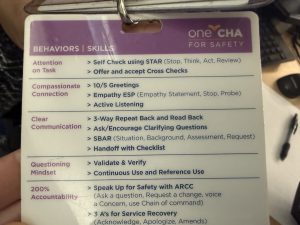 These behaviors, in turn, translate into specific skills, as depicted in the photo (right) of a “badge buddy” that all staff carry as a reference.
“There are two or three skills within each area that make it really granular,” explains Batalden. “These turn the general concept into things that are very explicit and specific. So, you can clearly know if you’re doing it or not.”
“Most of these behaviors are about people speaking up,” she continues. “We know that relationships among staff in healthcare institutions are hierarchical and it can be difficult for people to speak up against that authority gradient in the system. This model creates an expectation that they will raise issues — and establishes a safe culture in which to do so.”
Translating to the Front Line
O’Connor and Maloney believe these HRO practices have transformed the way that staff members at the Windsor Street Primary Care work together, leading to more reliable patient care and better patient experiences.
“We integrate these principles in many ways every day,” explained Maloney at the MHQP award ceremony. “We have daily huddles in the morning and multiple times throughout the day with different dyads, and we always bring up a safety story that goes along with these HRO behaviors. It creates an open space within our team to question each other, and to ask clarifying questions of each other if we don’t understand something. That constant communication keeps all of our fingers on the pulse for any issues that may arise that we can handle in the moment instead of letting them snowball.”
Dr. O’Connor believes one of the most powerful aspects of the HRO initiative is that it gives everyone in the organization a shared language to continuously process feedback, and it cultivates an environment where staff feel both empowered and responsible for identifying and voicing concerns.
She shares a recent example of how this has played out:
“Recently, the wrong vaccine was ordered. The nurse came and found me and, using a specific tool from the HRO behaviors called ‘cross check,’ she was able to say, ‘I want to cross check and actually see if this is what you meant to do.’ Just being able to use that naming and knowing everyone speaks that language has made them feel comfortable speaking up,” she says.
The Proof Is in the Results
Dr. Batalden is confident that HRO practices are here to stay across the CHA organization.
“More than anything, what sustains this initiative is that we’re seeing results,” she says. “We’ve had a more than 40% reduction in staff and patient harm events, a 10 percentage point improvement in our overall likelihood of recommending care at the institution, statistically significant improvements in provider and staff engagement, and a 50% reduction in patient complaints across the system. These are real results that reinforce our commitment to this every day.”
“And all of this trickles down to patient experience,” says O’Connor.