

Declining Primary Care Capacity: Facts from the Massachusetts Primary Care Dashboard
(January 2026)
Adequate primary care capacity is crucial for ensuring that people have access to comprehensive services, including preventive care and chronic disease management. However, many patients in Massachusetts are facing challenges in accessing primary care. Recent news reports shed light on the crisis. Tens of thousands of patients are losing their primary care clinicians due to changes in network affiliations and provider groups are turning to AI to help alleviate the challenges posed by the shortage.
The 2025 Massachusetts Primary Care Dashboard that the Massachusetts Center for Health Information and Analysis (CHIA) published in collaboration with MHQP offers insights into the root causes of a concerning decline in primary care capacity which is posing these significant access challenges for patients across the state.
As reported in the Dashboard, the percentage of primary care physicians in the state who exited primary care has risen to 5.5%, the highest it has been since this measurement began. What’s more, the percentage of Massachusetts-based physicians who practice in primary care has declined steadily from 30.4% in 2018 to 28.7% in 2023.
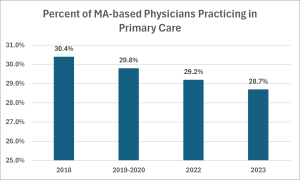
Several critical trends are contributing to this trend. One major factor is the aging of the primary care workforce. Many experienced physicians are nearing retirement, reducing the available capacity to meet patient demand. The percent of primary care physicians in Massachusetts who are older than 65 increased from 21.7% in 2022 to 22.2% in 2023.
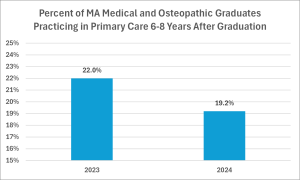
Meanwhile, the number of new physicians choosing to enter primary care remains low and has been decreasing in recent years. The percentage of Massachusetts medical and osteopathic graduates practicing primary care 6-8 years after graduation declined from 22.0% in 2023 to 19.2% in 2024. The imbalance between retiring providers and fewer new entrants is shrinking the pool of available primary care practitioners. However, there was a small increase in Physician Assistants working in primary care from 7.2 per 100,000 residents in 2022 to 7.9 in 2023. During the same period, the number of Nurse Practitioners working in primary care also grew from 4,029 to 4,364.
Primary care is the foundation of our healthcare system. Effective primary care promotes better patient outcomes, lower costs, and more equitable care. Reduced primary care capacity and the access problems it creates threaten to undermine quality healthcare for patients across the Commonwealth, especially as lack of access to primary care results in greater demand for more expensive hospital and emergency department services.
“It is critical that we safeguard primary care accessibility by supporting strategies that retain existing primary care clinicians, inspiring more medical students to specialize in primary care, and fostering innovative care models,” said Barbra Rabson, MHQP’s President and CEO. “Maintaining robust primary care capacity is crucial to keeping Massachusetts residents healthy.”