

Massachusetts Primary Care Dashboard Continues to Highlight Alarming Trends for Primary Care
(June 2026)
The Center for Health Information and Analysis (CHIA) has released its latest Primary Care Dashboard to monitor the health of the primary care system in Massachusetts in collaboration with MHQP.
The dashboard tracks the performance of the Commonwealth’s primary care system across six key domains: finance, capacity, utilization, access, care, and equity. This year’s release includes new measures related to prenatal and postpartum care, expanded data on primary care visits by payer type, and a new utilization domain that captures how individuals engage with the health care system.
Primary care services are foundational to a high-performing health care system. Strong primary care is associated with better patient outcomes, lower costs, and more equitable care. The information contained in the dashboard offers policymakers and industry leaders a robust, data-driven perspective on how the system is functioning and where targeted reforms may be needed.
 Key findings highlight ongoing challenges within the primary care workforce, patient access to care, and overall investment in primary care:
Capacity
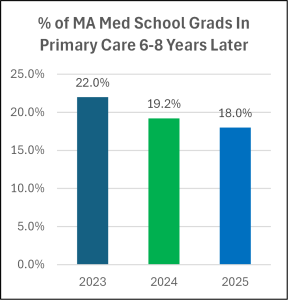
- The percentage of medical school graduates entering primary care has declined each year since 2022 — from 22.0% in 2023 to 19.2% in 2024 to 18.0% in 2025.
Access
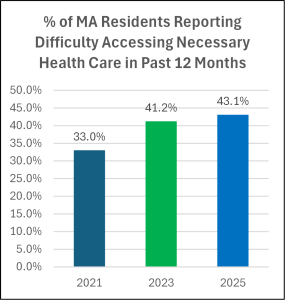
- At the same time, the proportion of Massachusetts residents who reported difficulties obtaining needed health care increased again — from 33.0% in 2021 to 41.2% in 2023 to 43.1% in 2025.
- I
 n 2025, 85.7% of Massachusetts residents reported having a usual source of care, compared with 88.9% in 2023.
Finance
- In 2024, MassHealth had the highest percentage of spending on primary care in the state (8.4%), followed by the commercially insured market (6.6%) and Medicare Advantage (4.2%).
- The percentage of spending on primary care in the commercially insured market declined from 7.0% in 2023 to 6.6% in 2024.
Together, these findings continue to spotlight concerns about a primary care system in distress and underscore the importance of sustained monitoring and targeted investment in primary care as Massachusetts continues to pursue system-wide reforms.
“Key performance data on the health of primary care in Massachusetts continue to move in the wrong direction and cannot be addressed soon enough,” said Barbra Rabson, MHQP’s outgoing President and CEO. “The state’s Primary Care Task Force is focused on strengthening primary care, which is the one specialty in our health care system that can simultaneously improve outcomes and increase life expectancy. When the primary care system is failing, overall population health declines, patients suffer with poorer outcomes, and our already unaffordable health care costs accelerate.”
“Massachusetts cannot afford to allow these trends to continue,” said Jane Barrow, MHQP’s incoming President and CEO. “A high-functioning primary care system lays the foundation for high-quality health care. I look forward to continuing MHQP’s strong legacy of providing data-driven insights to help propel improvement and lasting change in the state’s primary care system.”
“Continued investment in primary care is essential to building a more effective and equitable health care system in Massachusetts,” said CHIA Executive Director Andrew Jackmauh. “The dashboard highlights opportunities to better align resources with patients’ needs, particularly as the Commonwealth considers increasing the proportion of primary care spending to help control costs and improve health outcomes.”